Does any nation offer better wine value than Spain?
This seems obvious to French bottlers, who import major amounts of Spanish wine each year. Per the OIV’s World Wine Sector in 2025 report:
“France, the EU’s second-largest wine importer by volume, imported 5.3 mhl in 2025… Spain remained France’s leading supplier by volume, accounting for 65% of imports…”
Then again, Spain has a history of its products being leveraged. Perhaps the most famous case is olive oil, which has been flowing to Italy for some two thousand years.
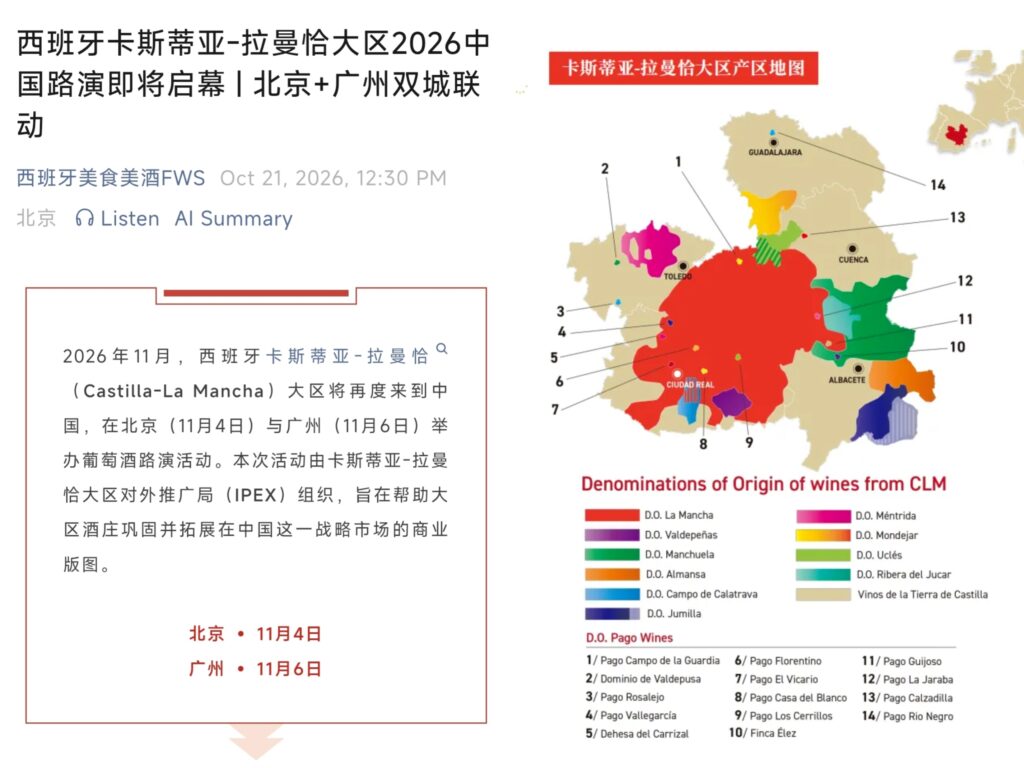
In any case, Spain’s value-for-money wine took the spotlight in Beijing yesterday as the Wines From Castilla–La Mancha Roadshow made a stop. They will be in Guangzhou tomorrow, November 6: see poster below to sign up.

Hopefully this trip results in sales as Spain has long underperformed in China given its top-three status as a global producer. Last year, Spain ranked fifth for volume in China, narrowly behind Italy but only a quarter of leader Australia, per WBO stats. For value, it dropped to sixth, below New Zealand, with a per-liter value only above Chile—by a few cents—among the top eight sources.
Frankly, Spanish wines deserve to be found across all price points, including entry level, which is where many of this week’s roadshow wines would snugly fit. Some angles I saw at this roadshow:
Priced by the Glass
Plenty of wines could fit even modestly priced by-the-glass listings. Think export prices of RMB12 to RMB24 per bottle—restaurants could even import it themselves—with more complex wines at RMB25 and up.
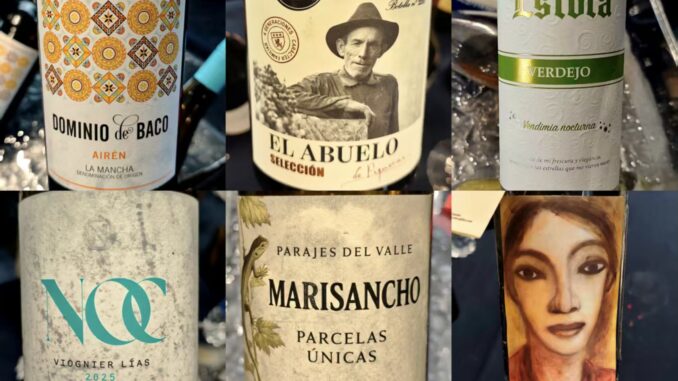
DCOOP is a good example. Its Airén—Spain’s most planted white grape—is fruity as expected but with a longer slightly spicy finish. The counterpoint red, an easy-drinking Tempranillo, is floral—notably roses—with fresh fruit and vibrancy. Both hail from this price point.
The Verdejo Factor
New Zealand Sauvignon Blanc ranks among the star performers in China in recent years, and Verdejo fits this universe with its fragrant aromas, bright acidity and zippy citrus character, all while bringing a bit more body. It’s also a lot less expensive.
Both Ayuso and Campos Reales offered easy-drinking Verdejo at low export prices. I also enjoyed Santa Cruz de Alpera’s Verdejo, aged three months on lees.
Spain Is the New France?
I found plenty of wines made with Spanish grapes like Tempranillo, Macabeo and Garnacha alongside French varieties like Cabernet Sauvignon, Syrah and Petit Verdot. And in some cases, blends crossing borders, meaning lots of choice.
Viña Aljibes Red is such a five-grape blend: grown at 1,000 meters—roughly the same altitude as Ningxia, it offered dark berries, hints of graphite and chocolate, and more tightness than some other wines.
Others include Santa Cruz de Alpera’s Garnacha, a fun drop using carbonic maceration, and its lively Syrah; NOC’s smooth, balanced Viognier; and Bodegas Ayuso Azares’ Petite Syrah, among others.
But the table I felt crushed it—admittedly I didn’t try every wine at the roadshow—was Piqueras.
The El Abuelo, a blend of Alicante Bouschet, Monastrell and Syrah, offered aromas of ripe dark berry, coffee and earth, and hints of barrel influence, including oak and vanilla. Taking my first sip, I was expecting something like a lush Barossa red, but this wine offered elegance and judicious oak use, especially for this price. A hat tip to the fellow attendee who suggested it.
Story Time
Finally, some wines had stories that made me want to try the bottle. This included quirky grapes, like Bodega Señorío de Júcar’s Marisancho, made from 100-year-old vines and aged three months in oak, with just 6,500 bottles made. (They also had a skin-contact Macabeo.)
And Los Aljibes’ Selectus Del Mar, a wine aged in bottle for six months 40 meters beneath the sea’s surface. Sadly, I was too late to try this one.
In any case, Spain faces the reality of a world awash in wine as consumer demand recedes. And in China, a history of low sales in terms of both volume and value. Thus, this is going to be an uphill battle. But for those seeking value, these wines are a good place to look.
By the way, if you are interested in exploring Spanish wines in China, I recommend the themed packs by Le Sommelier. These are based grape varieties or Spanish regions or wine styles–or sometimes just a very fun collection that includes bubblies, whites and reds. And they typically average less than RMB100 per bottle, although Le Sommelier does have pricier options, plus select wines from other countries.
For those strictly seeking icon wines—low-volume, high-scoring, hard-to-get bottles—Pasion is a must try. No one is pushing these brands harder than this importer.
(Get the free Grape Wall newsletter here. Follow on LinkedIn, Instagram, Facebook and Twitter. Grape Wall has no sponsors: help support the mission, including World Marselan Day via PayPal, WeChat or Alipay. Contact Grape Wall at grapewallofchina (at) gmail.com.)
Leave a Reply
You must be logged in to post a comment.