
“Focus on the vineyards.”
That was the advice Michel Rolland—the wine world’s most famous consultant—gave during a 2012 Shanghai panel called China Wine Revolution.
Rolland, who died last week at 78, had started consulting in China for mega producer COFCO—best-known for its GreatWall brand—a year earlier.
This coincided with peak optimism in China’s wine market.
In 2011 alone, bottled wine imports surged a whopping 65% by volume and 85% by value year-on-year, led by France, with China rising as the top export market for Bordeaux.
The wine trade was also pouring in, from trade fairs (ProWein and FCH China launched ProWine) to media (Wine Enthusiast and YesMyWine launched a magazine) to contests (Decanter started an Asia awards edition in Hong Kong) to shops (Enoterra, Torres and ASC grew their chains) to global brands (DBR Lafite in Shandong and LVMH in Yunnan and Ningxia were literally putting down roots).
Local wineries, east to west, also sought to join the action, Ningxia was leading the charge, joining the OIV as dozens of operations rose, including Helan Qingxue, fresh off a major award. I was even involved, co-organizing a Ningxia vs Bordeaux contest, then helping in Ningxia with a winemaking challenge and with a wine tasting co-chaired by Jancis Robinson and Ma Huiqin.
Many of these Chinese producers were seeking inspiratoin from or even emulating Bordeaux, where Rolland had first practiced.
But during that Shanghai panel, he urged caution. He warned that China was taking a “very industrial approach,” that growth was too quick, without sufficient attention to vineyards or grape suitability.
“We need to understand China, its soil, its climate. We can’t do the same as in Bordeaux or Chile,” he said.
This was also his fortieth Bordeaux vintage, he explained, noting how much change that region had witnessed over the years, from more flexible harvest times to decreasing yields per vine.
For China, Rolland said the priority was clear: the vineyards. He said winemaking was “almost easy” by comparison—what mattered were the grapes.

Drops of SunGod
In 2013, I gathered a mix of consumers and trade people in Beijing to taste seven wines from China, including one of Rolland’s works in progress from Chateau SunGod, COFCO’s nearby winery.
“This [wine] drew praise from most tasters,” I posted, noting they had found it “fresh, balanced and with good tannins,” with the professionals finding it generic.
“I like it, it’s generic, but good generic. That’s what you get with Michel Roland, the technical skill,” said one. Others cited a “good concentration of oak” and that is had some eucalyptus aromas.
These reactions captured why Rolland was the right consultant for the time.
Many China wineries then be happy with “good generic”, the kind of technically proficient wine that veered toward ripe fruit, velvety tannins and noticeable oak, backed by a Bordeaux pedigree and an international quality that could win medals.
Even so, Rolland’s emphasis on the vineyards—rather than his wine-making technique—may prove most important to his legacy.
Vineyard First
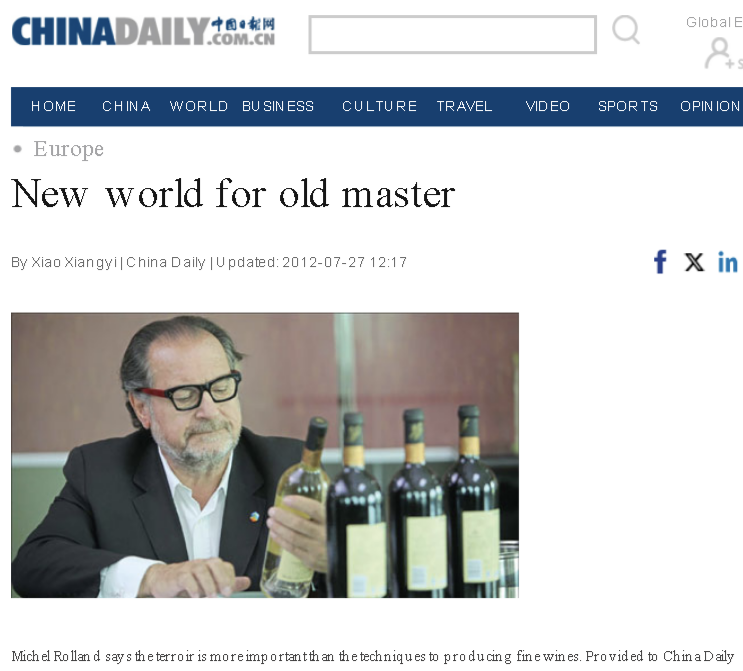
In 2012, China Daily reported how his hands-on approach surprised people.
Zhang Hui, technical director at COFCO’s SunGod winery, was surprised when Rolland arrived and headed straight to the vineyard—”dressed as a real farmer.”
“I thought he would first go to the labs for tasting or viewing the winemaking process,” Zhang was quoted as saying. Instead, Rolland “knelt down to examine the soils, picked off old leaves and demonstrated how to trim grape vines.”
“We used to pay more attention to the winemaking techniques,” said Zhang. “Now we’ve realized the importance of good management of vineyards.”
Changing Times
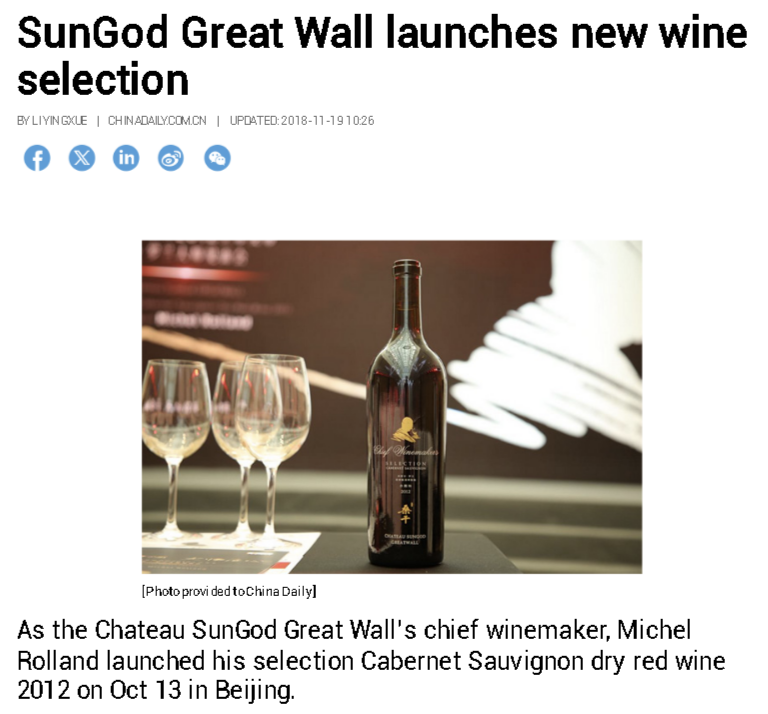
China Daily followed up in 2018, for the launch of Rolland’s SunGod Cabernet Sauvignon 2012.
By then, the market was peaking, about to start an overall decline, as imports softened and local producers struggled to convince consumers of the quality, and often high prices, of their wines.
One unexpected development from that heady year of 2012 was also still having a major impact: after taking power that year, Chinese leader Xi Jinping launched an anti-corruption campaign that sharply curtailed government entertainment budgets, including for expensive wines, a move that seemed like an existential threat to some producers.
That move shifted the focus to consumers, to people who drink more for pleasure than for status, for whom those prevalent red wines were less of a draw. This shift is still growing, with pleasure seekers growing and filling the vacuum.
In pursuit of these consumers, many producers across China, from Ningxia to Yunnan to Shandong have realized the need for more investment in and care of their vineyards. They have greater respect for quality fruit and, in turn, consumers.
The results show given how many wines of true character are arising, a testament to what Rolland stressed a dozen years ago—“focus on the vineyards.”
(This post first appeared in Grape Wall Newsletter. Subscribe for free here.)
(Get the free Grape Wall newsletter here. Follow on LinkedIn, Instagram, Facebook and Twitter. Grape Wall has no sponsors: help support the mission, including World Marselan Day via PayPal, WeChat or Alipay. Contact Grape Wall at grapewallofchina (at) gmail.com.)
Leave a Reply
You must be logged in to post a comment.