
Kathleen Burk’s path has gone from a mid-century California farm that grew grapes to writing a 600-page work on the world history of wine.
Her tome, Wine: A Global History, is due out October 1 and tells the story of this beverage—“a drink, a medicine, a ritual and a commodity”—across ten millennia. China is an intriguing part of that story.
In this Q&8, I ask Burk—Emeritus Professor of Modern and Contemporary History at University College London—about both China’s role in wine history and her own wine story, which includes wine judging, organizing tastings and writing Is This Bottle Corked? The Secret Life of Wine.
Check out the full Q&8 below. And find the full list of Q&8s here.
Grape Wall: Your youth is entwined with wine, from growing up in a family that farmed grapes to tasting in Napa Valley while attending Berkeley. How did those early experiences influence your view of wine?
Kathleen Burk: How those early experiences of working in the vineyards influenced me—and my five brothers and sisters—was that none of us wanted to spend our lives doing this. What I wanted to do was to make enough money so that I could afford to buy wine.
I should also add, however, that it gave me something of a feel for viticulture. When I visit a winery, I always like going out in the vineyards as do at least two of my sisters.
Riding pillion on a motorcycle around Napa tasting wines whilst at Berkeley merely confirmed the pleasure that I took in wine. Tasting quite good wines whilst at Oxford opened up the world of European wines to me.
During the past decade, China’s wines have received much press coverage, won thousands of international medals and received kudos from top critics, but that is still just a blip in the country’s alcohol history. What is the starting point for China and alcohol?
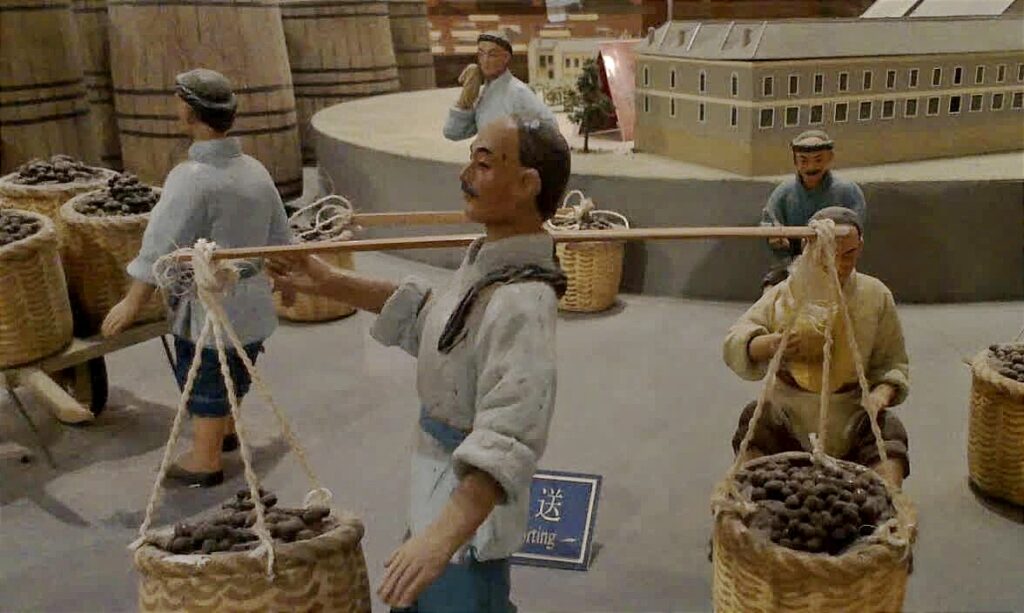
As far as we currently know from archeological finds, China’s alcohol history goes back to about 7000 BCE in Jiahu [in Henan province]. However, whilst it was an alcoholic drink, it was made from rice and honey, with added grapes or hawthorn, or possibly both. It was not grape wine.
In terms of Vitis vinifera, the species used for most of the world’s wines, it seems to have arrived in China just over 2000 years ago through the western frontier and has pleased people ever since. How did this species get a foothold?
The diplomat and explorer General Zhang Qian was sent to Central Asia in 138 BCE, and upon his return in 126 BCE he brought back cuttings of domesticated vinifera grapes from the Fergana Valley, now in Uzbekistan, to the Han capital in Chang’an, now Xi’an.
The Emperor had the cuttings planted all around the palace. Those planted within the palace grounds were tended by the Emperor himself.
Wine became an elite beverage, although the proportion of the population who drank grape wine, particularly amongst the middle classes, increased a bit during the Tang Dynasty.
The Tang Dynasty—from 618 to 907—ranks among the high points for wine in China, it being popular among the upper classes. Could you talk about the role alcohol has played in cultura and social relations throughout Chinese history.
Wine and poetry have been intertwined since the beginning—primarily, I imagine, with grain wine—remember Li Bai, the “poetry and wine saint.”
It has also been an important element in politics, not least in its use at banquets, where the quality of the wine could signify the relationship between the host and guest, or in international relations, between one country and another.
In times such as that of “The Sages of the Bamboo Grove”, who were essentially Taoists, drinking until drunk could open up your inner self. However, a man who drank excessive amounts of wine—much more than the civilised three cups—could also imply that he was something of a rebel.
And, as everywhere, wine can lubricate social and diplomatic relations.
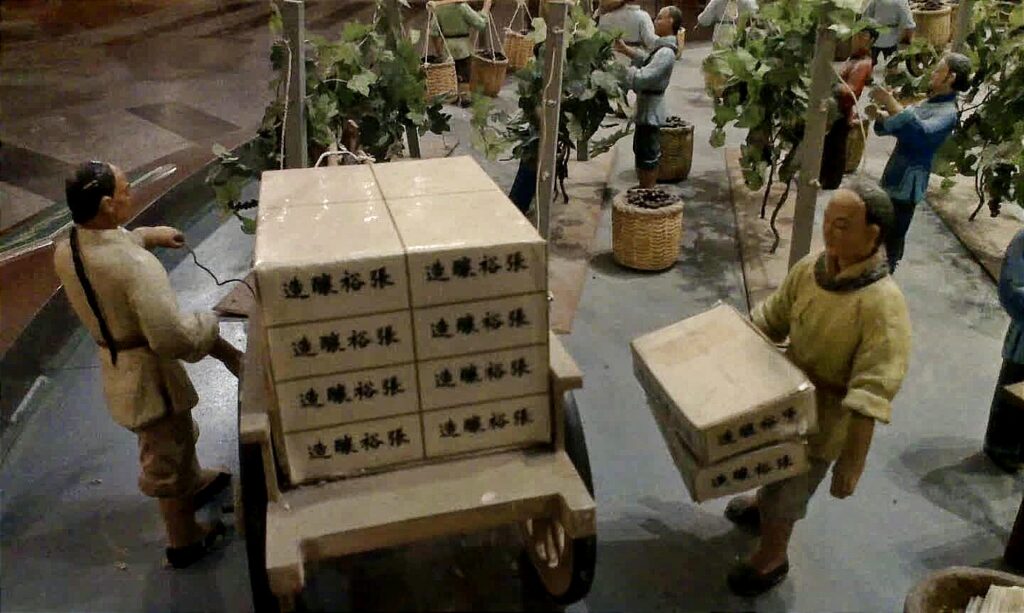
The “modern” era of Chinese wines has many intriguing tales, from 19th-century missionaries bringing vines to China, to Georgian grape varieties arriving during the era of friendship with the USSR, to the influx of major foreign producers in the 1990s as China started to open up. During your research, did you find a particular story or two that surprised you?
The Mongols had a stunning drinking capacity, and to show how generous they were, they liked to get their guests drunk. A comparison of the size of Han and Mongol wine glasses shows the extent to which the former, in order to retain the status of a real man, had to go to match the capacity of the latter. Mongol rulers equated drinking capacity with power, and what has been described by Janet Wang as ‘forceful persuasion’ came into play.
The Great Khan of the Mongols, Kublai Khan, forced his ministers to keep drinking, and if they could not keep up with others, they were stripped of their robes and headgear, a mock stripping away of their power, since they were clearly lightweights.
You are familiar with the upper echelons of what I call the vintelligentsia: in terms of education, you have a WSET diploma; in terms of writing, you have published in the World of Fine and Wine magazine; and in terms of contests, you are a judge in the International Wine & Spirits Competition.
Given the long history and large population of China, and the diversity of its cultures, cuisines and climates, do you think there is a risk of the vintelligentsia pushing foreign standards—a kind of Cabernet colonialism— with negative effects or will this be one of many example throughout history of China adapting outside influences to its own purposes?
I’m no longer a judge in the IWSC competitions, but since I still judge, you can refer to me as an international wine judge.
The term vintelligentsia is absolutely new to me—as you know, in the UK, being an intellectual or a member of an intelligentsia is something ascribed to you by others, not by yourself.
I suppose that you must mean those such as Jancis Robinson, Hugh Johnson and Andrew Jefford. Jancis pushes what I suppose one might call “foreign standards”, but these tend to be in the order of saying winemakers should keep their vessels used for making or holding wines clean. She is quite enthusiastic about Chinese wines demonstrating high standards.
If Chinese winemakers want to export, they have to produce wines up to Western standards, and, for easier acceptance, use familiar grape varieties—perhaps not Mare’s Teat—as many Chinese wines do. (I have some favourites myself.)
If they are concentrating on the domestic market, they can make what, and how, they wish. I don’t think that this is “Cabernet colonialism” or any other kind of colonialism.
I wonder if we could finish with the big picture: global wine production and consumption are steadily dropping; there is growing anti-alcohol sentiment in key markets; and younger generations are drinking less while having more choices; among other major challenges, including in China. How do you see this period in the grand sweep of world wine history and what do you foresee happening during the next decade?
I wrote nearly half a chapter on this topic—I can hardly do it justice in a few paragraphs.
At this point, China is not in particularly good shape beyond its premium wines, an important number of which are made by female winemakers.
Fortunately, there are a number of winemakers concentrating on making wines which are both affordable and good. Sadly, many other Chinese wines are not very good—there are adulterations and counterfeiting, a lack of clarity as to what a particular wine is made of, and just unpleasant tastes.
Wine consumption in China is falling—between 2023 and 2024, it fell by nearly 25%, whilst wine producers fell from 244 in 2017 to 119 five years later. If you can’t sell it, you don’t make it. I have no more idea—probably less than you do—as to the position of wine in China in the next ten years.
All winemaking countries are suffering a decline in sales. In many cases, it is the bulk wine producers that are suffering. The assumption, or hope, is that wine drinkers are drinking less but better, and that those who make good wine are more likely to survive.
(Get the free Grape Wall newsletter here. Follow on LinkedIn, Instagram, Facebook and Twitter. Grape Wall has no sponsors: help support the mission, including World Marselan Day via PayPal, WeChat or Alipay. Contact Grape Wall at grapewallofchina (at) gmail.com.)
Leave a Reply
You must be logged in to post a comment.