
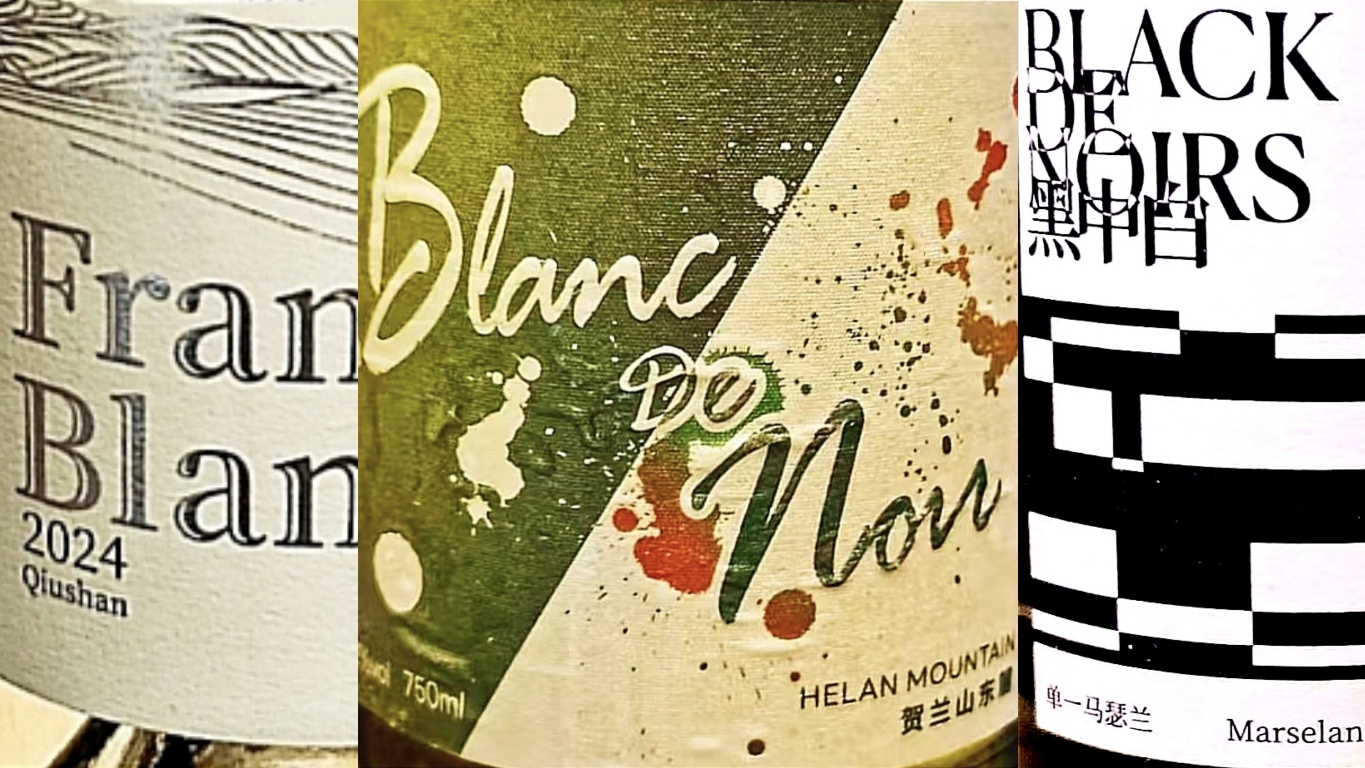
Call it ‘black is the new white.’
These past few years, we’ve seen more China producers embrace still blanc de noir / “white from black”, that is, white wine made with black, blue and red grapes.
This gives producers committed heavily, or solely, to dark varieties a way to use surplus fruit in a struggling market while leveraging the rising popularity of white wine.
The timeline between harvest and retail tends to be shorter and offers cash-starved wineries the chance to make money faster—cash for the next round of barrels has to come from somewhere.
And these wines offer something unique in a market where consumers are increasingly curious about wine.
A Gamay blanc de noir from Qiushan Valley? That is one box few consumers have ticked off.

The Great Diversification
It’s part of a nearly decade-long diversification of Chinese wines, as producers pursue a vast range of styles and grape varieties, including pet-nats, orange wines, bubblies, grape-based spirits—the local versions of brandy and grappa—and more.
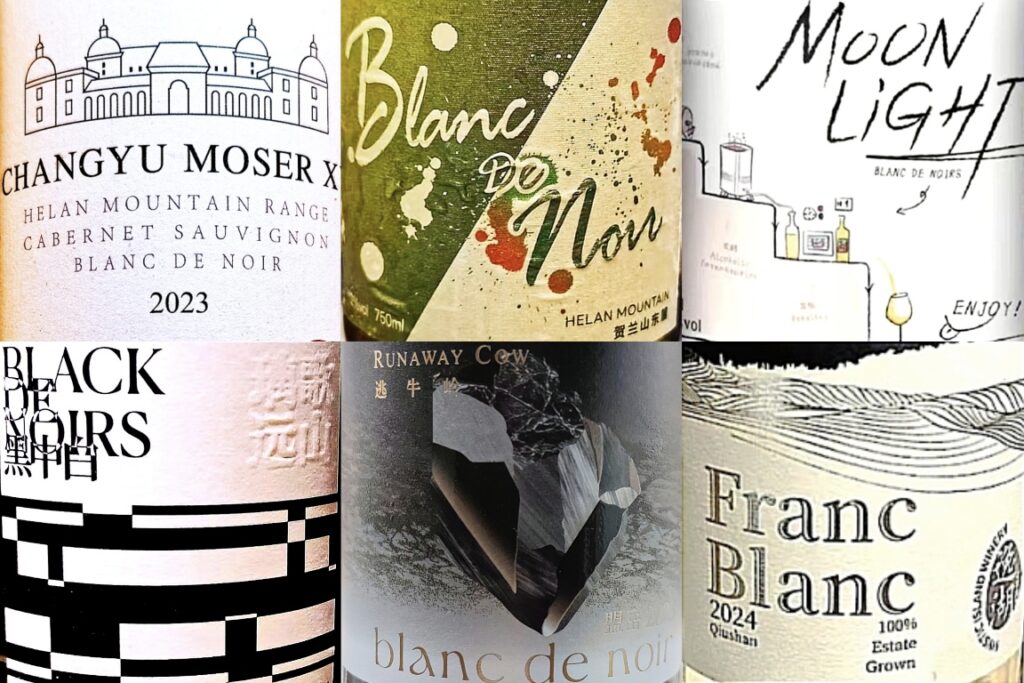
The first winery to make a blanc de noir splash in China was Ningxia’s Changyu Moser XV in 2016, where the vineyards are dedicated to Cabernet Sauvignon—skin contact is said to be 10 minutes maximum. That initial stainless-steel version was joined by a barrel-influenced one in 2017 and has been part of the portfolio ever since, with the wine also being bottled under the name Longyu.
In recent years, we have seen more producers releasing blanc de noir, using a wide variety of grapes. They include Lige Yuanshan (Marselan), Mystic Island (Cabernet Franc), Nine Peaks (Petit Verdot), Shepherd (Malbec), Xiban (Marselan), Soleil du Mont (Merlot) and, with that Gamay, Runaway Cow,
Ningxia’s Mountain Wave is among the latest to jump on board. The winery began by focusing on Malbec, Marselan and Pinot Noir a decade ago to differentiate itself from those planting the usual Bordeaux varieties. Mountain Wave’s first unoaked Malbec blanc de noir is set to be released for World Malbec Day on April 17, while its Pinot Noir sibling, after six to nine months in new oak, is set for Pinot Noir Day on August 18. (See my Q&8 with Mountain Wave owner Melvin Li here.)

California Connection
I’ve seen claims that Changyu-Moser’s was the world’s first white Cabernet Sauvignon, but one could find such wines in California more than five decades ago. In fact, the parallels with today’s China are intriguing.
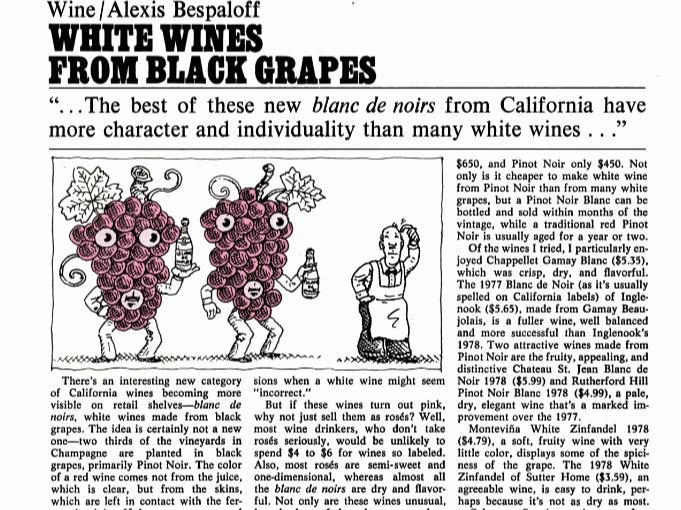
“Though most blanc de noirs are made from Pinot Noir, some are made from Zinfandel, Cabernet Sauvignon, or Gamay,” wrote Alexis Bespaloff in 1979 in New York magazine. “The reason they’re made at all is that the increased demand for white wines has resulted in a surplus of some red-wine grapes, especially Pinot Noir.”
(Bespaloff cites white Cabernets from Sterling and Montevina. And also notes that in 1978 good Chardonnay cost $850 per ton while Pinot Noir was $450!)
I followed up by contacting a veteran California-based wine observer, who told me his first blanc-de-noirs experience was a 1965 white cabernet from Ridge.
“Pinot Noir makes the best of these blanc de noirs,” said he. “All red grapes theoretically could produce a decent white wine, but they have to be harvested early. You have to set out to make a ‘white’ wine.”
“It will be very interesting to see how China reacts to these. Cabernet Franc, Malbec and Petit Verdot could make some interesting wines,” he added, while pointing to the story of white Zinfandel as a case study of blanc de noirs.
(A version of this post first appeared in the Grape Wall e-newsletter. Sign up for free here.)
(Get the free Grape Wall newsletter here. Follow on LinkedIn, Instagram, Facebook and Twitter. Grape Wall has no sponsors: help support the mission, including World Marselan Day via PayPal, WeChat or Alipay. Contact Grape Wall at grapewallofchina (at) gmail.com.)